
Finding the best sleep quality tracker can genuinely change your life. Most people have no idea what happens to their body during sleep, and without the right data, fixing poor sleep is just guesswork. In this article, we review five of the most reliable sleep tracker devices on the market today, covering smart rings, a smartwatch, and an under-mattress pad. Whether you are shopping for yourself or looking for the best sleep tracker for seniors in your family, this guide has everything you need. We cover features, real benefits, and honest user experiences so you can make the smartest choice.
Why Sleep Tracking Actually Matters
Sleep tracking devices monitor quality in ways that a simple alarm clock never can. They measure your heart rate, breathing patterns, time spent in each sleep stage, and how often you wake at night. That data gives you real insight into whether your sleep is restorative or not.
Most adults need between seven and nine hours of quality sleep. However, quantity is not the same as quality. You can spend nine hours in bed and still feel exhausted if your deep sleep is constantly disrupted. A good tracker tells you exactly what is going wrong so you can act on it.
The best sleep tracker for adults is one that fits your lifestyle, stays accurate over time, and does not require a PhD to interpret the results. Let us get into the five best options available right now.
1. RingConn Gen 2 Smart Ring: Best Overall Sleep Quality Tracker
What Makes It Stand Out

The RingConn Gen 2 earns the top spot because it combines cutting-edge features with a no-subscription model, making it one of the most reliable sleep trackers you can own long-term. It is the world’s first smart ring to include sleep apnea monitoring, which sets it apart from almost every competitor at this price point.
Sleep apnea is a condition where breathing repeatedly stops during sleep. Many people live with it for years without knowing. The RingConn Gen 2 screens for this using blood oxygen monitoring and breathing rate analysis throughout the night.
Beyond apnea detection, the ring tracks stress levels, heart rate, women’s health cycles, and overall sleep quality. It works with both Android and iOS, and it delivers up to 12 days of battery life. That means fewer interruptions to your charging routine and more consistent data over time.
Key Features and Benefits
The titanium body is lightweight and comfortable enough to forget you are wearing it. The companion app organises your sleep data into easy-to-read reports. Because there is no ongoing subscription fee, your total cost of ownership stays low after the initial purchase.
The 12-day battery life is a genuine advantage. Many competing devices need charging every day or two. With the RingConn Gen 2, you simply charge it once and enjoy nearly two weeks of uninterrupted tracking. For the best sleep tracker for home use, this is hard to beat.
Real User Experiences
James, 41, marketing consultant: “I have tried three different sleep trackers over the past two years. The RingConn Gen 2 is the first one I have actually kept wearing past the first month. The sleep apnea detection was what sold me. My doctor had suggested I might have mild apnea, and this ring confirmed it on multiple nights. I took the data to my appointment and it saved us a lot of back-and-forth. The battery life is also incredible. I charge it on Sunday nights and forget about it for the rest of the week.”
Clara, 35, physiotherapist: “What I love about this ring is that it tracks my heart rate variability during sleep, which is something I care about deeply as a health professional. The stress tracking is surprisingly accurate too. On nights after long clinical shifts, my stress score is noticeably elevated, and my sleep quality reflects it. The app is clean and well-designed. I also appreciate that there is no monthly fee. You pay once and you are done.”
2. POBOVi Gen 2 Titanium Smart Ring: Best Budget-Friendly Sleep Ring
What Makes It Stand Out

The POBOVi Gen 2 is one of the most accurate sleep trackers in the smart ring category for people who want solid performance without a high price tag. It tracks sleep stages, heart rate, and blood oxygen throughout the night, giving you a full picture of how well you are sleeping.
One of its most appealing qualities is that it requires no subscription. You buy it once, pair it with the free app, and start tracking immediately. For anyone tired of ongoing fees from fitness apps, this is a refreshing approach.
The titanium build is comfortable and durable. The ring is slim enough to wear all night without discomfort, even for people who are not used to sleeping with anything on their hands. The brand also recommends sizing before buying, which shows a thoughtful commitment to getting the fit right.
Key Features and Benefits
Sleep stage tracking with the POBOVi Gen 2 covers light sleep, deep sleep, and REM sleep. This level of detail helps you understand not just how long you slept but how restorative that sleep actually was. Deep sleep is when your body repairs itself. REM sleep is when memory consolidation happens. Knowing whether you are getting enough of both is extremely useful.
The heart rate tracking is continuous, which means it captures data throughout the night rather than at intervals. This makes it one of the most accurate sleep trackers in its price range. For those looking for the best sleep tracker wearable that does not break the bank, the POBOVi Gen 2 is a strong contender.
Real User Experiences
David, 58, retired teacher: “I am not a technology person by nature, but my daughter suggested I try a sleep tracker to understand why I wake up feeling tired most mornings. The POBOVi Gen 2 was easy to set up. Within the first week, I could see that I was barely getting any deep sleep. I made a few changes to my evening routine, and within two weeks, my deep sleep percentage improved noticeably. The app is simple enough that I can understand everything without needing help.”
Sophie, 29, graphic designer: “I bought this ring mostly to track my sleep cycles, and it has delivered exactly what I expected. The data is consistent, the ring is light, and I do not have to worry about a subscription. I compared its readings against a friend’s much more expensive device and the results were very similar. For the price, this is genuinely impressive. The sizing guide was also very helpful. I would have ordered the wrong size without it.”
3. Withings Sleep Tracking Pad: Best Sleep Tracker for Home Without Wearing Anything
What Makes It Stand Out
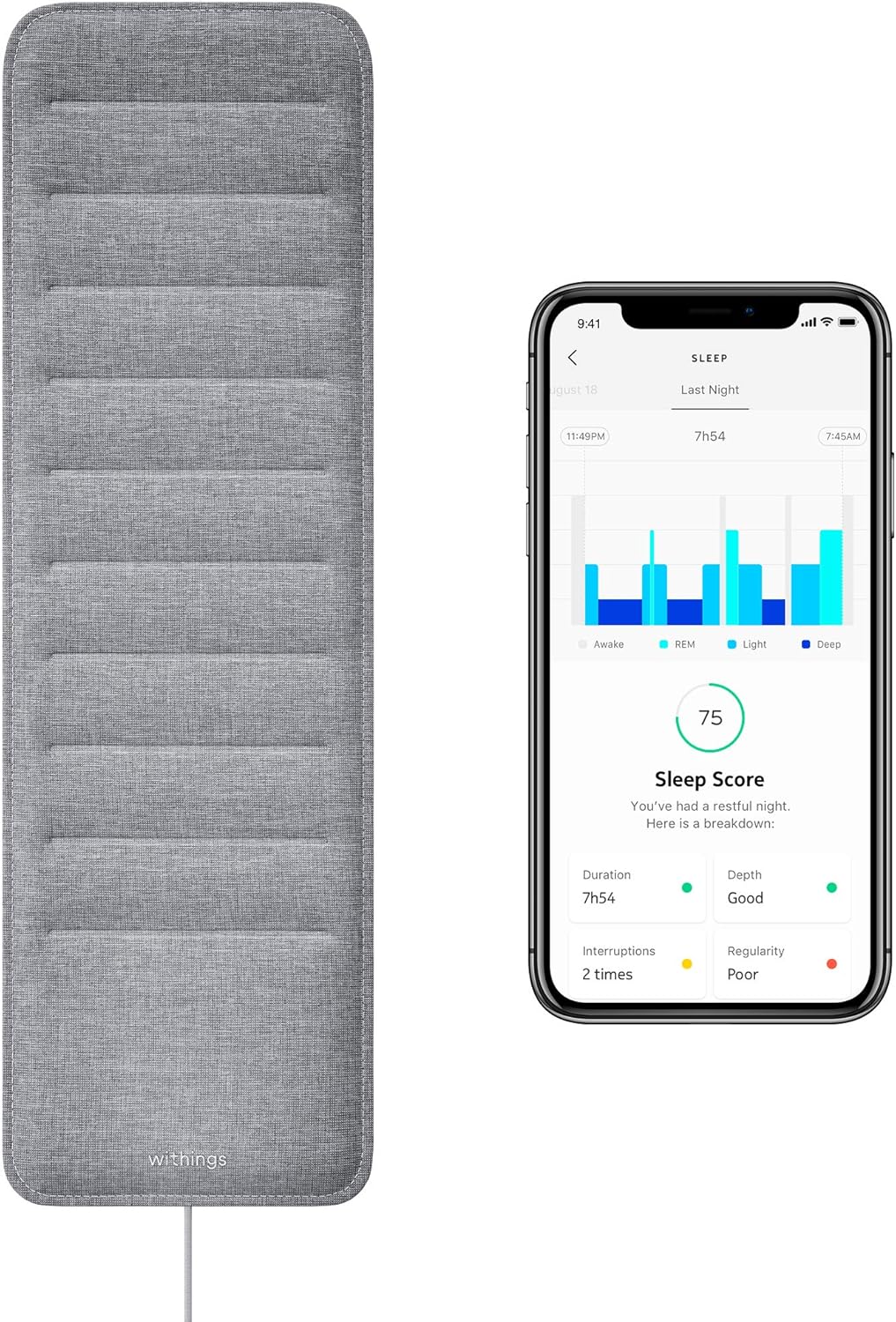
Not everyone wants to sleep with something on their wrist or finger. The Withings Sleep pad solves this problem elegantly. You place it under your mattress, and it tracks your sleep without any contact with your body at all. This makes it the best sleep tracker for seniors who may find wearables uncomfortable, and also for anyone who moves around a lot during sleep.
The device uses a sensitive sensor to detect your breathing patterns, heart rate, and movements through the mattress. It then translates that data into a detailed sleep analysis inside the Health Mate app. The setup takes just a few minutes, and after that, it works automatically every night.
Withings has a long reputation for building quality health devices, and the Sleep pad reflects that. The data is detailed enough to satisfy health-conscious users but presented simply enough for casual users to understand.
Key Features and Benefits
The Sleep Cycle Analysis feature breaks down how much time you spent in light, deep, and REM sleep each night. It also tracks snoring, which can be an indicator of sleep apnea or nasal congestion. Over time, the app builds a sleep score that helps you spot trends and identify habits that hurt or help your sleep.
Because you never have to charge the pad or remember to wear it, the data is incredibly consistent. Sleep tracking devices monitor quality best when they collect data every single night without interruption. The Withings Sleep pad makes this effortless. It is arguably the best sleep tracker for home use for people who dislike wearables.
Real User Experiences
Margaret, 67, retired nurse: “I am at an age where wearing gadgets to bed just does not appeal to me. When my son suggested the Withings pad, I was sceptical. However, it turned out to be the perfect solution. I just slide it under the mattress and forget it is there. The app sends me a summary every morning, and I can see exactly how I slept. It picked up that I was snoring heavily on the nights I had wine with dinner, which was an eye-opener. I have cut back, and my sleep quality has improved.”
Tom, 44, software engineer: “My wife and I share the bed, and I was worried the pad would pick up her movements too. Actually, it handles this really well if you position it properly under your side. The heart rate data is surprisingly accurate for a non-contact device. I have been using it for four months, and I can clearly see how my late-night screen time affects my REM sleep. The data has genuinely changed my evening habits.”
4. Oura Ring Gen 3 Heritage: Most Sophisticated Sleep Wearable
What Makes It Stand Out

The Oura Ring Gen 3 Heritage is widely considered one of the most sophisticated best sleep quality tracker devices available. It has built a loyal following among biohackers, athletes, and health professionals who want deep, nuanced data about their recovery and sleep.
The ring tracks over 20 biometric signals, including skin temperature, heart rate variability, respiratory rate, and detailed sleep stages. It synthesises all of this into a daily Readiness Score, a Sleep Score, and an Activity Score. These three numbers give you a clear, actionable summary each morning.
Battery life runs between five and seven days, which is shorter than some competitors but still strong enough for most users. The ring is water-resistant up to 100 metres, so you can swim and shower without removing it.
Key Features and Benefits
The Readiness Score is one of the Oura Ring’s most loved features. It tells you, based on your overnight data, how prepared your body is for physical or mental exertion that day. If your score is low, it recommends rest and recovery. This is particularly useful for athletes and active individuals who want to train smarter rather than harder.
The sleep stage breakdown is among the most detailed available in a wearable. However, it is worth noting that the Oura Ring requires a monthly membership after the first year for full feature access. For some users, this is a worthwhile investment. For others, it is a drawback compared to no-subscription competitors.
Real User Experiences
Rachel, 32, personal trainer: “I have been using the Oura Ring for eight months, and it has changed how I plan my training weeks. When my Readiness Score is high, I push hard. When it is low, I scale back. My recovery has improved significantly since I started listening to the data instead of just grinding through workouts regardless of how I feel. The sleep tracking is incredibly detailed. I can see the exact moment my sleep quality dips, and I have traced it back to eating late at night.”
Marcus, 48, entrepreneur: “The Oura Ring is beautiful and the data is excellent. My only frustration is the subscription. After spending a significant amount on the ring itself, paying monthly for full access feels like a second purchase. That said, the quality of the insights is genuinely unmatched among everything I have tried. The temperature tracking alone has helped me identify a pattern where my sleep quality drops whenever I am fighting off a cold, before I even feel symptoms.”
5. Fitbit Versa 4: Best Smartwatch for Sleep Monitoring
What Makes It Stand Out

If you prefer a traditional smartwatch over a ring or pad, the Fitbit Versa 4 is the best smartwatch for sleep monitoring in this price range. It combines full smartwatch functionality with detailed sleep tracking, GPS, and 24/7 heart rate monitoring.
The Versa 4 tracks your sleep stages nightly and provides a Sleep Score each morning. It also calculates a Daily Readiness Score, telling you whether your body is ready for intense activity or needs recovery. A three-month Google Health Premium membership is included with purchase, which adds deeper health insights during your initial months of use.
With over 40 exercise modes and built-in GPS, this is a device that earns its place on your wrist around the clock. Most accurate sleep trackers in the smartwatch category rarely offer this level of all-day fitness integration at this price.
Key Features and Benefits
The Fitbit app is one of the most user-friendly platforms in the sleep tracking space. It presents your sleep data in clear charts, tracks trends over weeks and months, and offers personalised guidance to help you improve. The Daily Readiness feature is particularly valuable because it connects your sleep quality directly to your exercise capacity.
Battery life is decent for a smartwatch with a screen, though it needs charging more frequently than a ring. The 24/7 heart rate tracking gives you continuous data throughout the night, making it one of the most accurate sleep trackers with a display.
For anyone who wants their sleep tracker and smartwatch to be the same device, the Versa 4 is an excellent choice. It is also a strong pick as the best sleep tracker for adults who are already in the Fitbit or Google ecosystem.
Real User Experiences
Aisha, 26, medical student: “I use the Fitbit Versa 4 for both exercise tracking and sleep monitoring, and it handles both really well. During exam periods, my sleep score consistently drops, and the app flags the change immediately. It helps me realise when I need to prioritise sleep over late-night studying. The GPS is also genuinely useful for my morning runs. Having everything in one device simplifies my life a lot.”
Greg, 52, accountant: “I switched to the Versa 4 from a basic fitness band last year, and the difference in sleep data quality is remarkable. The sleep stages breakdown actually helped me realise that my deep sleep was very low, which explained my constant daytime fatigue. I started going to bed 30 minutes earlier and cutting out coffee after 2pm. Within three weeks, my deep sleep improved and I felt noticeably better. The Google Health premium membership was also a nice bonus during the first few months.”
How to Choose the Right Sleep Tracker for You
Consider Your Comfort and Lifestyle
The best sleep quality tracker is the one you will actually use every night. Smart rings are great for people who find watches bulky. The Withings pad is ideal for anyone who does not want to wear anything at all. Smartwatches suit people who want a single device for fitness and sleep.
Think About the Data You Need
Some sleep tracking devices monitor quality at a surface level, while others go extremely deep. If you just want a general overview, the Fitbit Versa 4 or POBOVi Gen 2 will serve you well. If you want clinical-level detail including sleep apnea screening, the RingConn Gen 2 is the clear choice.
Watch Out for Subscription Costs
Some of the most reliable sleep tracker devices, like the RingConn Gen 2 and POBOVi Gen 2, charge nothing after purchase. Others, like the Oura Ring, require monthly fees for full features. Factor this into your total cost before buying.
Battery Life Matters More Than You Think
A tracker with a short battery life will occasionally have gaps in your data. The RingConn Gen 2’s 12-day battery virtually eliminates this problem. Rings and pads generally outlast smartwatches when it comes to battery performance.
Final Verdict
Each of these five devices earns its place on this list. However, if you want a single recommendation, the RingConn Gen 2 delivers the best combination of advanced features, no subscription fees, and extraordinary battery life. It is the best sleep quality tracker for most adults in 2025.
For those who prefer no wearables, the Withings Sleep Pad is unbeatable. For smartwatch fans, the Fitbit Versa 4 leads the pack. Budget shoppers will find tremendous value in the POBOVi Gen 2. And tech enthusiasts who want elite-level biometric data will find it hard to look past the Oura Ring Gen 3.
Whatever you choose, investing in a sleep tracker is investing in your health. Because sleep affects everything from your mood to your immune system to your long-term heart health, understanding it is one of the smartest decisions you can make.