
Back pain exercises for women are not just a trending fitness topic; they are a genuine lifeline for millions of women dealing with daily discomfort. If you have ever woken up with a stiff, aching lower back, you already know how much it can slow you down. The good news is that you do not need a gym membership or complicated equipment to start feeling better.
In this guide, we will walk you through four simple, science-backed back pain exercises for women that target the root causes of back discomfort. Whether you are dealing with soreness from long hours at a desk, postural strain, or muscle weakness, these exercises will help. They are beginner-friendly, low-impact, and gentle enough to do at home today.
Why Back Pain Is So Common in Women
Back pain does not discriminate, but there are reasons it affects women so frequently. Hormonal changes, pregnancy, postural patterns, and differences in hip and pelvic structure all play a role. In addition, many women spend long hours sitting at work or standing on their feet, both of which strain the lower back over time.
However, the biggest contributor to chronic back pain in women is often muscle weakness. When the muscles that support the spine, the glutes, core, and lower back, are underused or underdeveloped, the spine bears more load than it should. This is why strengthening back exercises for women is not just helpful, they are essential.
Exercise does not have to be intense to be effective. In fact, gentle, targeted movement often works better than high-impact workouts for relieving and preventing back pain. The four exercises in this article are specifically chosen because they are safe, accessible, and proven to support spinal health.
What Happens When You Ignore Back Pain
Many women push through back pain, assuming it will go away on its own. Sometimes it does. But when discomfort becomes a recurring issue, ignoring it only makes things worse. Tight, weak muscles become tighter and weaker over time. Poor posture reinforces itself. Everyday activities like carrying groceries, picking up children, or sitting through a work meeting become increasingly uncomfortable.
Therefore, taking action early matters. Adding just a few simple back exercises for women to your weekly routine can make a significant difference. You do not need to spend hours exercising. Even 10 to 15 minutes a day can help you build the strength and mobility your back needs to function well.
It is also worth noting that not all back pain requires rest. In most cases, gentle movement is actually more therapeutic than lying still. Movement increases blood flow to the muscles, reduces stiffness, and helps maintain healthy tissue. So if your back is sore, the answer is often to move carefully and intentionally.
Before You Begin: A Few Important Notes
Before diving into the exercises, keep a few things in mind.
First, if your back pain is severe, sudden, or accompanied by symptoms like numbness, tingling, or pain that shoots down your leg, please see a doctor or physiotherapist before trying any new exercise routine.
Second, these exercises are designed to be gentle. You should never feel sharp or worsening pain while doing them. A mild, comfortable stretch or gentle muscle engagement is normal. Sharp pain is not.
Third, consistency matters more than intensity. Doing these exercises three to five times per week will deliver far better results than doing them intensely once or twice. Think of this as a long-term habit, not a quick fix.
Now, let us get into the exercises.
The 4 Best Back Pain Exercises for Women
Exercise 1: Cat-Cow Pose
What It Is
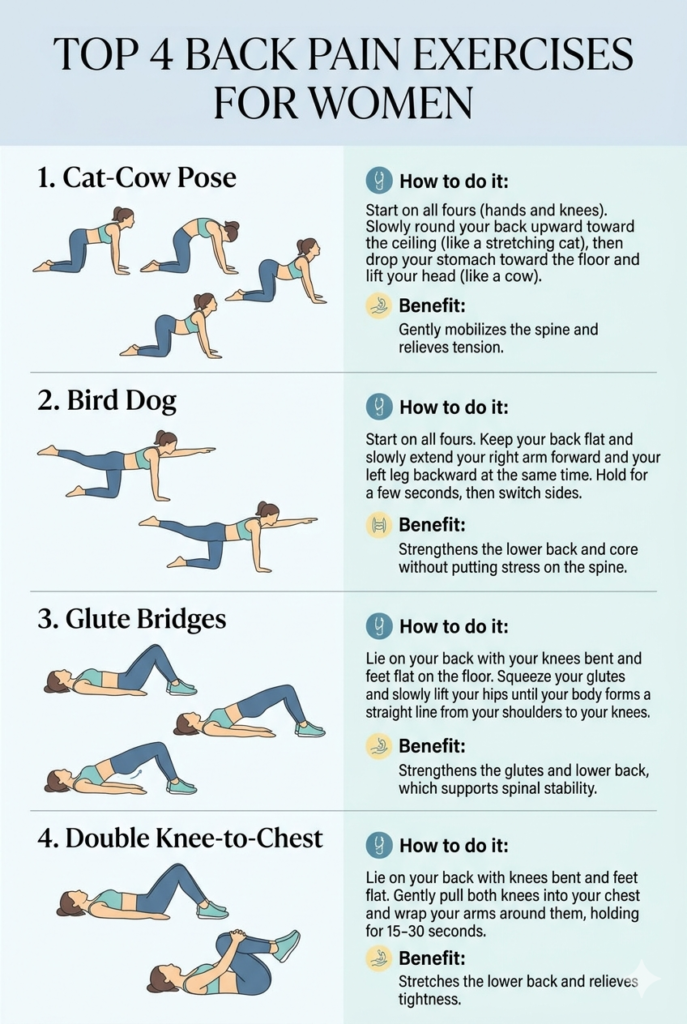
Cat-Cow is a well-known yoga-inspired movement that gently mobilises the spine. It is one of the most accessible and effective sore back exercises for women because it requires no equipment, puts no stress on the joints, and can be done in just a few minutes.
How to Do It
Start on all fours, with your hands directly below your shoulders and your knees below your hips. Your back should be flat, like a tabletop.
Breathe in slowly. As you exhale, round your back upward toward the ceiling — like a cat arching its back. Tuck your chin toward your chest and draw your belly button up toward your spine. Hold this for two to three seconds.
Then, as you inhale, drop your stomach down toward the floor and lift your head gently upward. Your lower back should curve inward slightly, and your tailbone should tilt up. This is the “cow” position. Hold for two to three seconds.
Move slowly and smoothly between these two positions. Aim for eight to ten repetitions.
Why It Works
Cat-Cow works by gently flexing and extending the entire spine from the neck down to the tailbone. This movement lubricates the spinal joints, releases tension in the muscles along the back, and helps restore a healthy range of motion.
For women who sit for long hours, this exercise is especially valuable. Sitting compresses the spinal discs and locks the spine in one position. Cat-Cow actively counteracts that compression by moving the spine through its natural range of motion.
It is also a brilliant way to warm up before any workout, making it a foundational part of any back workouts for women beginners programme.
Exercise 2: Bird Dog
What It Is
The Bird Dog is a classic rehabilitation and back strength exercise for women that targets the lower back, glutes, and core simultaneously. Despite its simplicity, it is one of the most effective exercises for building the deep stabilising muscles that protect the spine.
How to Do It
Begin on all fours, just as you did for Cat-Cow. Keep your back flat and your core lightly engaged, imagine bracing as if someone is about to gently poke your stomach.
Slowly extend your right arm forward while at the same time extending your left leg backwards. Your arm, back, and leg should form a straight line parallel to the floor. Avoid letting your hips twist or your lower back sag.
Hold this position for three to five seconds, then slowly return to the starting position. Repeat on the other side — left arm forward, right leg back. That is one full repetition.
Aim for eight to twelve repetitions on each side.
Why It Works
The Bird Dog is effective because it trains your body to stabilise the spine against movement, which is exactly what your back muscles need to do during everyday activities like walking, carrying, and bending.
It directly strengthens the erector spinae (the muscles running along the spine), the glutes, and the deep core stabilisers. All of these are critical for strong back muscles female health, and long-term pain prevention.
Because this exercise works both sides of the body independently, it also helps identify and correct muscular imbalances. Many women find one side is significantly weaker than the other, and addressing this imbalance often leads to noticeable improvements in back comfort.
Exercise 3: Glute Bridges
What It Is
Glute Bridges are a powerhouse move for anyone dealing with lower back pain. They are one of the best back strength exercises for women because they directly target the gluteal muscles, which are closely connected to spinal stability.
How to Do It
Lie on your back on a comfortable surface. Bend your knees so your feet are flat on the floor, hip-width apart. Your arms should rest by your sides.
Take a breath in. As you exhale, squeeze your glutes firmly and slowly lift your hips off the floor. Continue lifting until your body forms a straight line from your shoulders to your knees. Imagine pressing your feet into the floor as you rise.
Hold at the top for two to three seconds, keep squeezing those glutes, then slowly lower your hips back down.
Aim for ten to fifteen repetitions. As you build strength, you can hold the top position for longer.
Why It Works
The glutes are among the most powerful muscles in the body, and they play a critical role in supporting the lower back. However, many women have underactive glutes, often due to prolonged sitting, which forces the lower back to compensate. Over time, this compensation pattern leads to chronic tension and pain.
Glute Bridges directly address this by activating and strengthening the glutes in a safe, controlled way. As the glutes get stronger, the lower back can relax and be properly supported.
This exercise is also highly versatile. It forms a cornerstone of any full back workout for women, and it can be easily progressed over time by adding a resistance band, increasing the hold time, or eventually moving to single-leg variations.
Exercise 4: Double Knee-to-Chest Stretch
What It Is
The Double Knee-to-Chest stretch is one of the most immediately satisfying sore back exercises for women. It provides fast, gentle relief from lower back tightness and is especially helpful first thing in the morning or after long periods of sitting.
How to Do It
Lie on your back with your knees bent and feet flat on the floor. Gently bring both knees toward your chest by lifting your feet off the ground.
Wrap your arms around your shins — or clasp your hands together just below your knees and gently hug your knees in toward your chest. You should feel a comfortable stretch across your lower back.
Hold this position for 15 to 30 seconds while breathing slowly and deeply. Release, lower your feet, and repeat two to three times.
Why It Works
This stretch gently lengthens the muscles of the lower back and releases compression in the lumbar spine. It is particularly effective after activities that load the lower back, like strength training, walking for long distances, or sitting at a desk all day.
The Double Knee-to-Chest stretch also targets the hip flexors and piriformis muscle, both of which can contribute to lower back pain when tight. By addressing all of these areas together, this simple stretch delivers broad relief with minimal effort.
It is an ideal closer for any workout session, and it works just as well as a standalone morning stretch routine. Including it as part of your back pain exercises for women routine ensures your muscles stay long and supple between strengthening sessions.
How to Put It All Together: A Simple Weekly Routine
Now that you know the exercises, let us talk about how to structure them into a realistic routine. Here is a simple programme you can follow three to five times per week.
Warm-Up (2 minutes): Take a short walk around the room, do some gentle shoulder rolls, and perform a few slow Cat-Cow repetitions to warm up the spine.
Main Routine:
- Cat-Cow Pose — 10 repetitions
- Bird Dog — 10 repetitions each side
- Glute Bridges — 12 to 15 repetitions
- Double Knee-to-Chest Stretch — hold 20 to 30 seconds, 3 rounds
Total Time: Approximately 15 to 20 minutes.
This routine covers both the strengthening and mobility components your back needs. The Bird Dog and Glute Bridges build strong back muscles and a stable core. The Cat-Cow and Knee-to-Chest exercises maintain flexibility and relieve tension.
For best results, try to do this routine consistently, even on days when your back feels fine. Prevention is far more powerful than treatment, and a few minutes of daily movement can stop pain from returning.
Additional Tips to Support Your Back Health
Exercise is the foundation of back health, but a few lifestyle habits can make a big difference too.
Improve your posture. Whether sitting at a desk or standing in a queue, try to keep your spine in a neutral position. Avoid slouching forward or arching your lower back excessively. A well-positioned spine distributes load evenly and reduces strain.
Strengthen your core. Your core muscles, including the deep abdominals, work closely with your back muscles to support the spine. Adding simple core exercises like dead bugs or modified planks to your routine will complement your back workouts for women beginners beautifully.
Stay hydrated. The intervertebral discs, the cushions between your spinal bones, are largely made of water. Staying well-hydrated helps maintain disc health and flexibility.
Move regularly throughout the day. If you sit at a desk for long hours, set a timer to get up and move every 45 to 60 minutes. Even a short walk to the kitchen or a minute of gentle stretching makes a real difference.
Sleep in a supportive position. Sleeping on your side with a pillow between your knees is often recommended for lower back comfort. Sleeping on your stomach tends to increase spinal stress, so try to avoid it if possible.
When to See a Professional
Most back pain responds well to gentle exercise and lifestyle adjustments. However, some situations require professional attention.
See a doctor or physiotherapist if your back pain is severe or getting worse, if you experience pain that radiates down your leg (especially if accompanied by numbness or tingling), if you have unexplained weight loss alongside back pain, or if your pain was caused by a fall or injury.
A physiotherapist can also provide a personalised assessment and guide you through back workouts for women that are tailored to your specific needs and history. Do not hesitate to seek support, your back health is worth it.
The Long-Term Picture: Building a Strong, Resilient Back
The four exercises in this guide are a powerful starting point. However, true back health is a long-term commitment. As you build strength and confidence, you can gradually progress by adding more repetitions, trying new exercises, or exploring a structured full back workout for women that includes rows, deadlifts, and other compound movements.
The key is to start where you are. You do not need to be fit, flexible, or experienced to begin. These exercises are specifically designed for everyday women busy, real and looking for something that actually works.
Every repetition of Cat-Cow, every Bird Dog hold, every Glute Bridge, and every gentle knee-to-chest stretch is a vote for your long-term health. Over weeks and months, those small actions compound into genuine, lasting change.
Conclusion
Back pain does not have to be a permanent part of your life. With the right back pain exercises for women, you can relieve tension, build real strength, and protect your spine for years to come.
The four exercises covered in this guide — Cat-Cow Pose, Bird Dog, Glute Bridges, and Double Knee-to-Chest — form a simple, complete, and beginner-friendly routine. They are gentle enough for sore days and effective enough to create real, lasting improvement.
Start today. Roll out a mat, set aside 15 minutes, and give your back the care it deserves. You will likely notice a difference sooner than you expect — and your future self will thank you for it.
Always consult a qualified healthcare provider before starting a new exercise programme, particularly if you are managing a medical condition or recovering from an injury.